
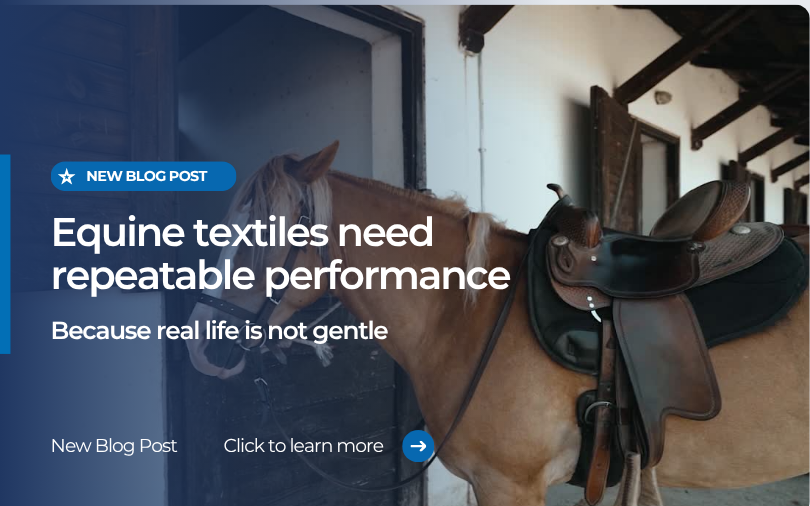
When equine textiles brands talk about premium rugs, most of the conversation focuses on what customers can see: fabric weight, design, fit, hardware and colourways.
Those things matter, but they are not what decides customer satisfaction over time.
The real test of an equine rug happens after the first week of use.
Rugs live in environments that are unpredictable and demanding. They deal with sweat, damp mornings, stable dust, friction points, and constant handling. Some are used in mosquito season, where nuisance and irritation can impact comfort and performance. Others are worn as winter rugs and liners, where warmth and moisture management become part of the everyday reality.
For equine product developers, this creates a clear challenge: how do you build textile performance that holds up when real life takes over?
Real-life conditions that test equine textiles and products
Equine textiles are exposed to a mix of conditions that most consumer textiles do not face at the same intensity.
Cotton summer rugs and fly gear are often used during warmer months. They are worn for long periods, exposed to heat and movement, and can become damp through sweat or humidity. In mosquito season, horses may be distracted and uncomfortable, which is why brands look for options that support better outcomes without relying on temporary solutions.
Winter rugs and liners face a different set of pressures. They are designed to retain warmth, which can also increase moisture and create an environment where hygiene performance matters. The inner lining and fibres do a lot of the heavy lifting here, even though they are rarely the first thing customers talk about.
Then there are fly masks and boots. These products sit close to the horse, experience friction and sweat, and can develop odour quickly if hygiene build-up settles into the textile structure. When this happens, customers notice. Not because a product looks different, but because it feels different to use and maintain.
Why built-in treatments are a product design decision
A common mistake in any textile category is treating hygiene performance like an add-on. If performance depends on sprays, surface applications, or aftercare routines that customers cannot realistically maintain, the experience becomes inconsistent.
That is why built-in treatments can play a role in equine textiles product development.
HealthGuard® works with brands to incorporate treatments into textiles during manufacturing, supporting hygiene performance within treated articles. For equine applications, this can include:
- anti-microbial treatments for rug linings, fibres and inner layers where damp and build-up are common
- anti-odour treatments for sweat-prone areas like boots and high-contact gear
- anti-mosquito options for cotton summer rugs and fly gear where insect nuisance is a real concern
These treatments are not about making louder claims. They are about creating a more consistent product experience, especially for categories where daily washing is not realistic.
Performance that repeats builds trust
Premium equine brands are built on trust. Customers return to the brands that feel consistent, practical, and designed for real life.
That consistency matters in product performance and also in how confidently a brand can position its quality.
HealthGuard® biotechnology is tested, traceable and compliant, designed to support real-world use at scale. For equine brands and manufacturers, this provides a strong foundation for repeatable outcomes across production runs.
If you are developing equine textiles like rugs, liners, fly masks, or boots and want to explore how built-in treatments can elevate product quality and customer satisfaction, get in touch today.

Stay up to date with the latest HealthGuard® education and news by following us on Instagram and Facebook.
 English
  简体中文
简体中文